Hallo guys ..how are you today??? i hope you good 💓💓
Today i want to tell about "Recount text"
What is recount text????
Recount
text is a text that telling the reader about one story, action or
activity. Its purpose is to entertain or informing the reader. Or a text
which retells event or experiences in the past.
Generic Structure of Recount Text
| √ | Orientation | : | It
gives the readers the background information needed to understand the
text, such as who was involved, where it happened, and when it happened. |
|---|
| √ | Events | : | A series of events ordered in a chronological sequence. |
| √ | Re-orientation | : | A personal comment about the event or what happened in the end. |
The Characteristics / Language Feature of Recount Text:
1. | Using the simple past tense, past continuous tense, past perfect tense, and past perfect continuous tense. |
2. | frequent
use is made of words which link events in time, such as next, later,
when, then, after, before, first, at the same time, as soon as she
left, late on Friday, On Saturday. On Monday, On Sunday). |
3. | Focus on a specific participant, e.g. I (the writer). |
4. | Using the conjunctions, such as: then, before, after, etc. |
5. | Using an action verb, e.g. went, stayed. |
6. | the passive voice may be used, eg. the bottle was filled with ink (Factual Recount). Example : Biography
Johannes Gutenberg  Biography:
Johannes Gutenberg introduced the concept of movable type and the
printing press to Europe. While this may not sound like a big deal at
first, the printing press is often considered as the most important
invention in modern times. Think about how important information is
today. Without books and computers you wouldn't be able to learn, to
pass on information, or to share scientific discoveries.
Prior to Gutenberg introducing the printing press, making a book was a
laborious process in Europe. It wasn't that hard to write a letter to
one person by hand, but to create thousands of books for many people to
read was nearly impossible. Without the printing press we wouldn't have
had the Scientific Revolution or the Renaissance. Our world would be very different.
Johannes was born in Mainz, Germany around the year 1398. He was the son
of a Goldsmith. Not a whole lot more is known about his childhood. It
appears he moved a few times around Germany, but that's about all is
known for sure.
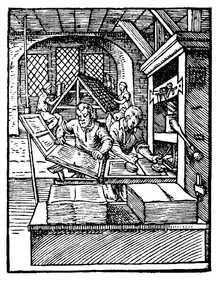
Printing Press in 1568 by Jost Amman
Gutenberg took some existing technologies and some of his own inventions
to come up with the printing press in the year 1450. One key idea he
came up with was movable type. Rather than use wooden blocks to press
ink onto paper, Gutenberg used movable metal pieces to quickly create
pages.
Gutenberg introduced innovations all the way through the printing
process enabling pages to be printed much more rapidly. His presses
could print 1000's of pages per day versus only 40-50 pages with the old
method. This was a dramatic improvement and allowed books to be
acquired by the middle class for the first time in the history of
Europe. Knowledge and education spread throughout the continent like
never before. The invention of the printing press spread rapidly
throughout Europe and soon thousands of books were being printed on
printing presses.
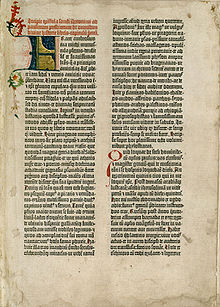
Gutenberg Bible Page
by Johannes Gutenberg
It's thought that the first printed item from the press was a German
poem. Other prints included Latin Grammars and indulgences for the
Catholic Church. Gutenberg's real fame came from producing the Gutenberg
Bible. It was the first time a Bible was mass produced and available
for anyone outside of the church. Bibles were rare and could take up to a
year for a priest to transcribe. Gutenberg printed around 200 Bibles in
a relatively short time.
Fun Facts about Gutenberg
- In 1462 he was exiled from Mainz. However, things turned around for
him and in 1465 he was given a fancy title, a yearly salary, and more as
a reward for his invention.
- The original Bible sold for 30 florins. This was a lot of money back
then for a commoner, but much, much cheaper than a hand written
version.
- There are around 21 complete Gutenberg Bibles existing still today. One of these Bibles is likely worth around $30 million.
|


Komentar
Posting Komentar